
Dental Product Quality: What Clinics Should Consider Before Buying
Key indicators for evaluating dental product provenance, raw material standards, manufacturing precision, and vendor reliability.
Hanudent Clinical Editorial Team
Endodontic & Materials Research Group
Table of Contents
In an increasingly crowded dental consumables marketplace, clinics frequently face the dilemma of balancing overhead costs with product quality. However, evaluating dental consumables solely on upfront unit price often masks substantial downstream liabilities in chair time, remakes, and clinical complications.
1. The Hidden Costs of Compromised Quality
When a rotary file separates in the apical third of a calcified molar, or an ill-fitting gutta percha point fails to achieve a hydraulic apical seal, the cost of retreatment, referral, and patient dissatisfaction far outweighs any nominal savings on initial purchase price.
Quality in dental instruments translates directly into clinical safety, reduced stress during complex appointments, and predictable procedural outcomes.
2. Verifying Manufacturing Transparency
One of the clearest indicators of reliable quality is direct manufacturing transparency. Historically, Indian dental clinics relied on unbranded imports with variable metallurgical consistency and minimal accountability.
Hanumat Global's establishment of India's state-of-the-art dental rotary file manufacturing facility at Bio 360 Life Sciences Park in Thiruvananthapuram represents a paradigm shift. Local manufacturing with strict quality control means verified medical raw materials, precision CNC grinding, and traceable batch consistency.
3. Dimensional Accuracy and Batch Consistency
A rotary file or gutta percha point marked as size 25 with an 04 taper must match international ISO specifications precisely. Substandard manufacturing often permits dimensional variances of up to 0.05mm—sufficient to cause binding, loss of working length, or over-instrumentation of delicate apical tissues.
Clinics should demand products that undergo optical laser measurement and documented quality inspections before leaving the production line.
4. Packaging Integrity and Sterility Guarantees
Sterile single-blister or sealed multi-pack presentations protect instruments from environmental oxidation, moisture ingress, and accidental physical blunting during transit and storage. Ensure that product labeling clearly displays lot numbers, manufacturing dates, taper markings, and recommended motor parameters.
Request Clinical Samples & Quotes for Your Practice
Discuss your operatory needs directly with Hanudent's product team. Fast WhatsApp assistance and factory-direct pricing.
Products Featured in this Article
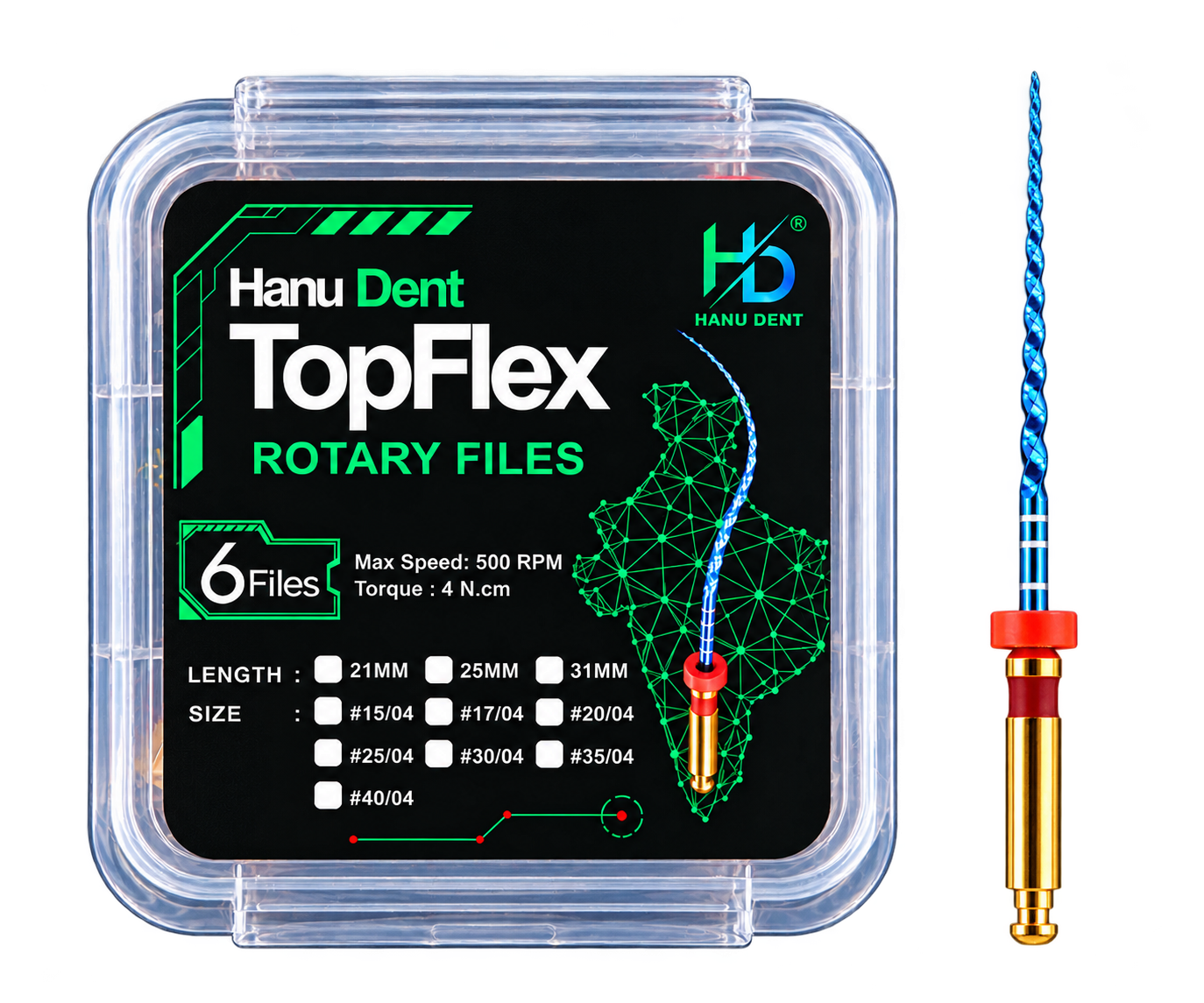 Featured400-450 RPM / 4 N·cm
TopFlex Rotary Files
Flex Beyond Limits — Advanced Thermal NiTi Precision
 Featured
Gutta Percha Points (Marked)
Millimeter-Marked Cones for Hermetic 3D Canal Obturation
Hanu Dent Diamond Burs
Multi-Layer Natural Diamond Bonding for Smooth, Rapid Reduction
Continue Reading
How to Choose the Right Dental Instruments for Your Practice
A practical clinical guide on evaluating material metallurgy, ergonomics, tactile sensitivity, and sterilization compatibility when selecting dental instruments.
A Practical Guide to Rotary Files in Endodontics
Understanding heat-treated NiTi metallurgy, glide path management, cyclic fatigue resistance, and torque protocols to prevent instrument separation.